

Last updated: March 2026
Use this page to connect GitKraken Desktop to a GitLab Self-Managed server so you can authenticate with a personal access token, manage SSH keys, discover repositories, and work with pull requests in your self-hosted GitLab environment. This integration requires a Pro subscription tier or higher.
Note: GitLab Self-Managed integration requires a Pro subscription tier or higher.
Requirements and limits
- Integration covered here: GitLab Self-Managed
- Plan: Pro subscription tier or higher
- Supported server versions: GitLab Self-Managed releases from the past year
- Authentication: Personal access token with
apiandread_userscopes - Token setup note: Leave token expiration blank when following this workflow
- Account limit: One GitLab Self-Managed account per profile; use Profiles for multiple accounts
- SSH behavior: GitKraken uses the key in Preferences > SSH unless you configure a GitLab-specific key or system SSH Agent
| Requirement | Value |
|---|---|
| Plan | Pro subscription tier or higher |
| Supported server versions | GitLab Self-Managed releases from the past year |
| Authentication | Personal access token |
| Required token scopes | api, read_user |
| Token setup note | Leave expiration blank when following this workflow |
| Account limit | One GitLab Self-Managed account per profile |
| SSH behavior | Uses Preferences > SSH unless overridden by a GitLab-specific key or system SSH Agent |
Quick Start
- Go to Preferences > Integrations in GitKraken Desktop.
- Select GitLab Self-Managed, enter your host domain, and click Generate a token on GitLab.
- Log in to your GitLab instance, generate a Personal Access Token with the
apiandread_userscopes (leave expiration blank), and copy the token. - Paste the token into GitKraken Desktop and click Connect.
To configure SSH access after connecting:
- In Preferences > Integrations, click Generate SSH key and add to GitLab to generate and upload a key automatically.
- Or click Add key to GitLab to upload your existing SSH default.
Once connected, GitKraken Desktop lets you clone from your self-hosted repository list, add remotes, and create or view pull requests. To manage more than one GitLab Self-Managed account, use multiple profiles with a GitKraken Pro plan.
What the GitLab Self-Managed integration lets you do
- Create new repositories with optional .gitignore and license files.
- Automatically generate an SSH key and upload it to GitLab Self-Managed.
- Save authentication credentials using profiles.
- Clone from your GitLab Self-Managed repository list.
- Add and manage remotes for GitLab Self-Managed.
- Create and view pull requests.
- Manage GitLab Self-Managed Issues.
How to authenticate with GitLab Self-Managed
Note: GitKraken supports any version of GitLab Self-Managed released within the past year.
Use GitLab Self-Managed integration when: your repositories live on a self-hosted GitLab server and you need PAT-based access. Don’t use the GitLab.com page when: your environment requires self-managed host domains, self-hosted auth, or server-version compatibility checks.
To authenticate:
- Navigate to Preferences > Integrations in the upper-right corner.
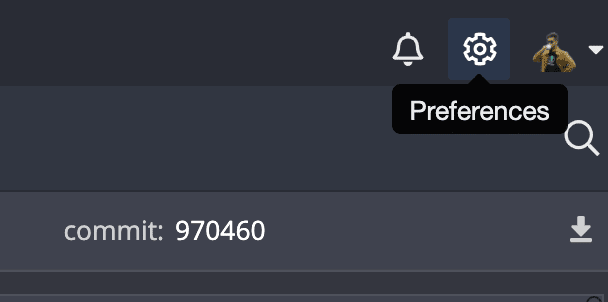
- Choose Gitlab Self-Managed. Enter your GitLab Self-Managed host domain. Click and follow the link.
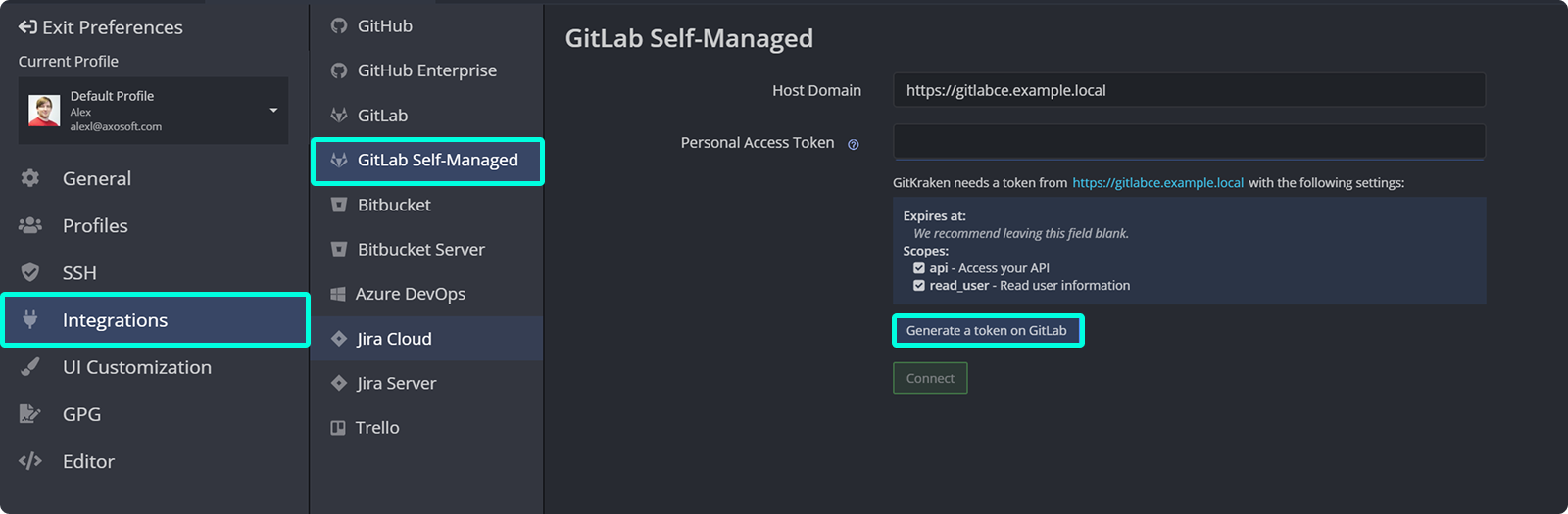
- In your browser, log in and generate a token. Required scopes:
apiandread_user. Leave expiration blank.
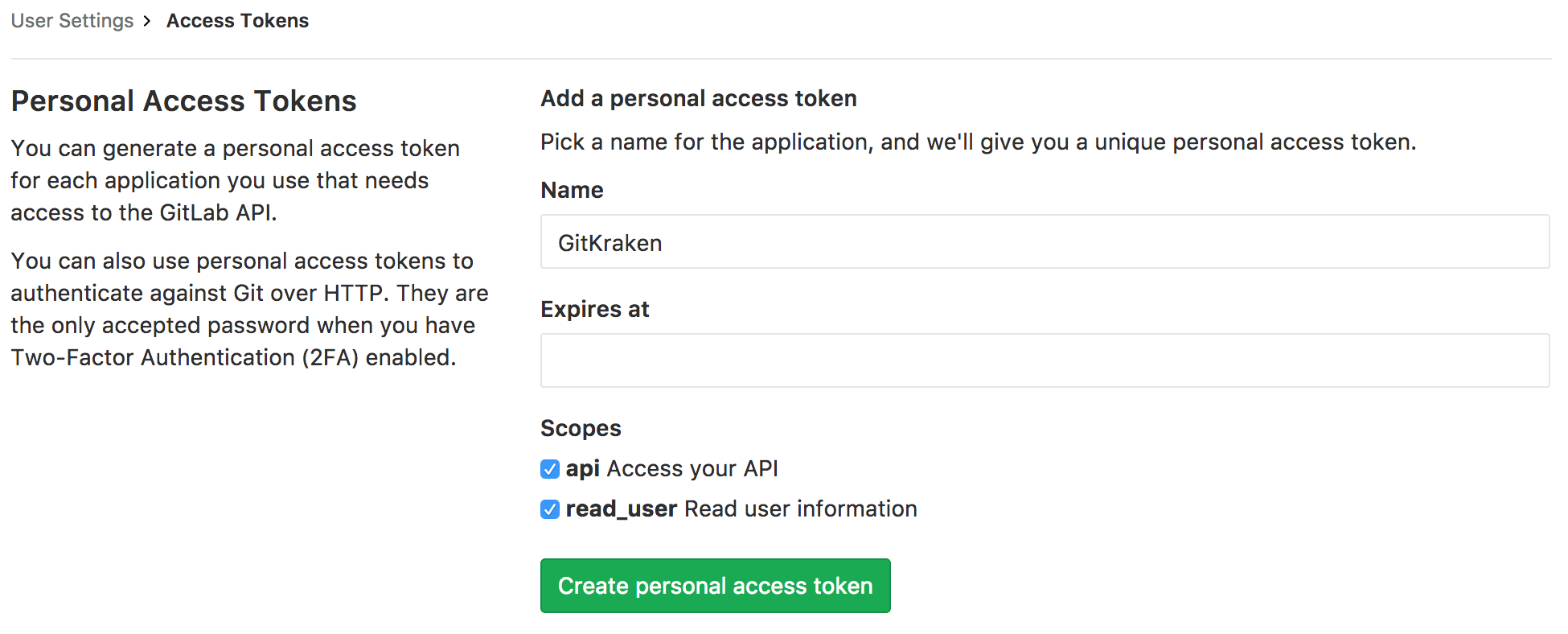
- Copy and paste the token into GitKraken, then click .
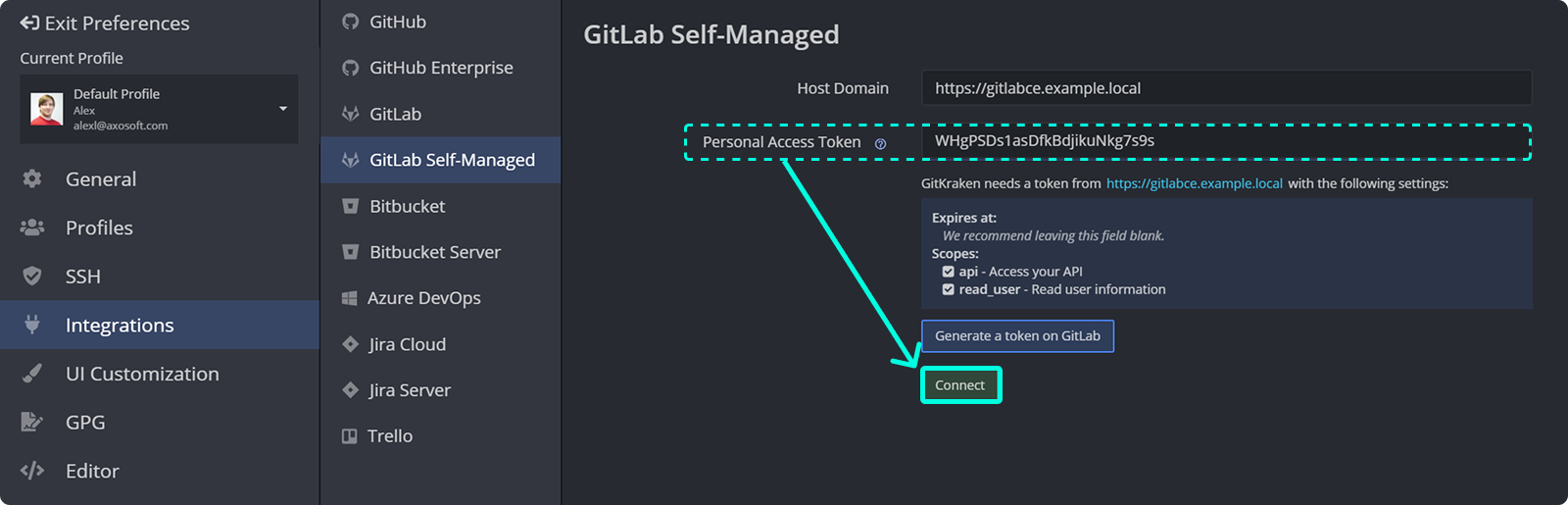
How to generate an SSH key for GitLab Self-Managed
Note: GitKraken uses the SSH key from Preferences > SSH unless overridden with a GitLab-specific key or a system SSH Agent.
- Open Preferences > Integrations.
- Click .
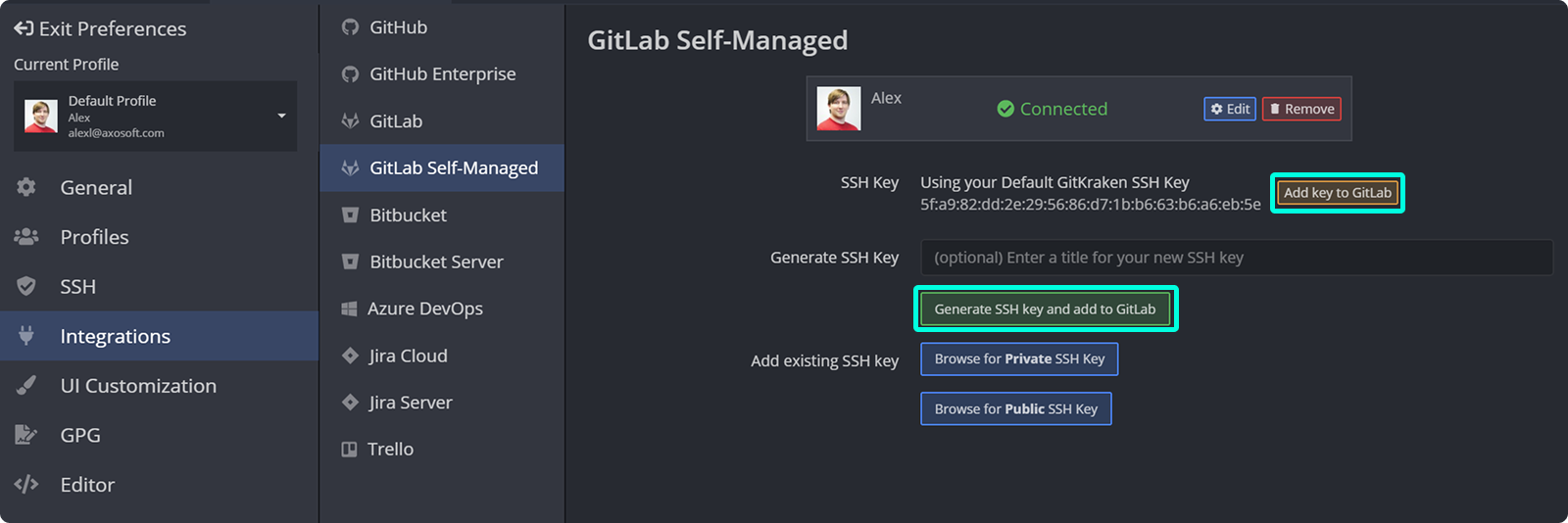
You can also:
- Use for an existing SSH Default.
- Use Add existing SSH key to upload a saved key manually.
How to connect multiple GitLab Self-Managed accounts
GitKraken supports one GitLab Self-Managed account per profile. Use multiple profiles with GitKraken Pro to manage separate accounts.
Use multiple profiles when: you need to switch between separate GitLab Self-Managed servers or identities. Don’t use multiple profiles when: one self-hosted account already covers the repositories you need to manage.
